
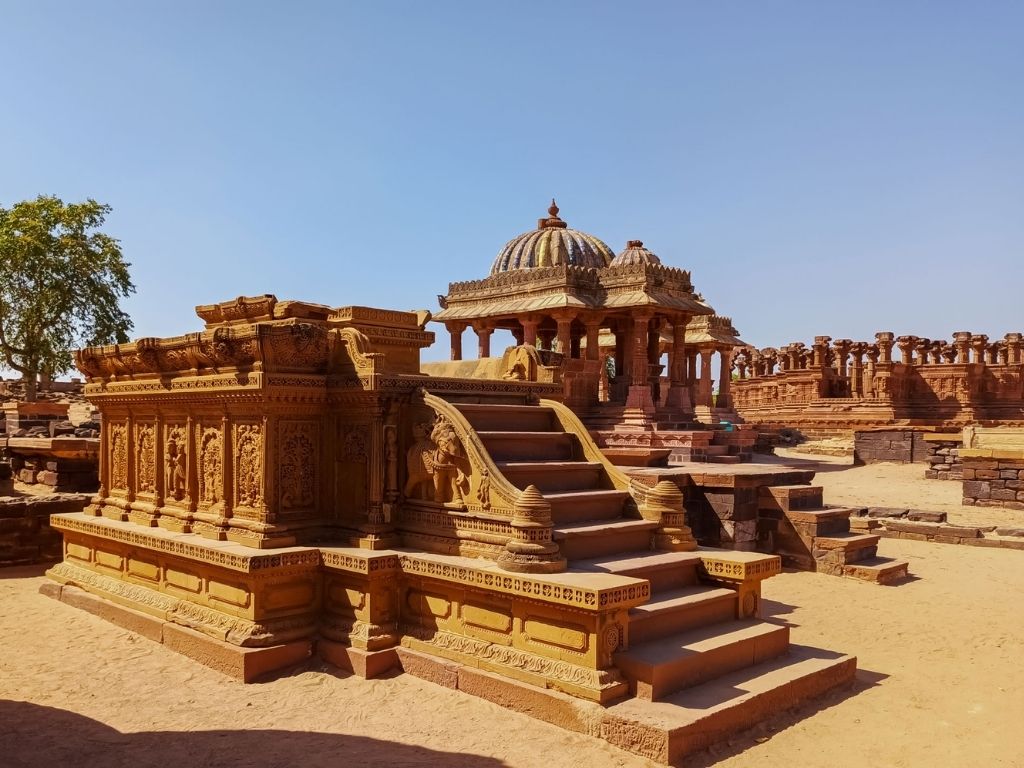
Chhatardi Bhuj
Bhuj, Gujarat 370001
If you are planning to visit Chhatardi Bhuj, we at Rann Utsav Stays can help you plan your itinerary, arrange and book your stay and travel, or get you a customised tour package.
This place is hauntingly beautiful. The Chhatardi are the royal cenotaphs, or memorial tombs, for the rulers of Kutch. They are these incredible, intricately carved structures made of red sandstone. Many were damaged in the 2001 earthquake, but their broken, tilted forms have a powerful, poetic beauty.
Echoes of Royalty: The Poignant Beauty of the Royal Chhatardi
On the serene banks of Hamirsar Lake, standing in silent, weathered grace, are the Royal Cenotaphs of Kutch, known locally as the Chhatardi of Bhuj. These are not palaces or forts, but magnificent memorial tombs built to honour the royal members of the Jadeja dynasty. With their intricately carved sandstone pillars, striking polygonal shapes, and beautifully sculpted domes, the Chhatardi are a breathtaking example of Rajput architecture and artistry. A visit here is a quiet, contemplative journey into the heart of Kutch's royal history, a place where the grandeur of the past meets a poignant, timeless beauty.
What Makes the Chhatardi a Must-Visit Historical Site
This collection of royal cenotaphs is one of the most architecturally significant and visually stunning sites in Bhuj.
- Exquisite Rajput Architecture: The structures are renowned for their intricate carvings. Look closely at the pillars, panels, and ceilings to see detailed depictions of deities, hunting scenes, and dancing figures.
- A Photographer's Paradise: The combination of the red sandstone structures, the play of light and shadow through the ornate pillars, and the often-overgrown, atmospheric surroundings make Chhatardi an incredibly photogenic location.
- A Poignant Atmosphere: Though damaged by the 2001 earthquake, the cenotaphs' weathered and partially ruined state adds to their profound sense of history and poignant beauty. It feels like a place lost in time.
- The Grandest Memorial: The largest and most impressive cenotaph is dedicated to Maharao Lakhpatji, a powerful ruler and patron of the arts, whose tomb is a masterpiece of stone carving.
History and Significance
The practice of building 'chhatris' (elevated, dome-shaped pavilions) as memorials is a tradition rooted in Rajput culture. The Chhatardi in Bhuj were constructed over several centuries to commemorate the lives of the Maharaos of Kutch. These were not burial sites, but grand cenotaphs where funerary rites were performed. The largest among them, dedicated to Rao Lakhpatji, was built in the mid-18th century. Unfortunately, this magnificent complex suffered extensive damage during the 2001 earthquake, with many of the domes and pillars collapsing. Today, it stands as a beautiful ruin, a powerful reminder of both the glory of the past and the destructive power of nature. It’s a historical counterpoint to the city's other royal residences like Prag Mahal and Aaina Mahal.
The Experience: A Walk Among Kings
A visit to the Chhatardi is a quiet and reflective experience. As you walk through the complex, you can't help but be in awe of the sheer artistry of the stone carvers. Take your time to admire the detailed panels and the majestic scale of the structures. The partially collapsed sections reveal the inner workings of the architecture, adding an almost archaeological feel to the visit. The silence of the place, often accompanied by the cooing of pigeons, allows for a peaceful connection with the history that surrounds you. It’s a place to slow down and appreciate the intricate details that tell the story of a bygone era.
Chhatardi Bhuj: Key Information
| Location | On the southwestern bank of Hamirsar Lake, Bhuj, Gujarat 370001. |
| Timings | Open all day, from sunrise to sunset. |
| Entry Fee | Free. |
| Time Required | 30 to 45 minutes. |
| Famous For | Royal Cenotaphs, Rajput Architecture, Intricate Carvings, Photography. |
How Rann Utsav Stays Curates Your Historical Tour
Understanding the full story of Kutch's royalty requires visiting not just their palaces but also their memorials. At Rann Utsav Stays, we craft comprehensive Bhuj city tours that connect these historical dots. A visit to the Chhatardi is perfectly paired with a relaxing stroll along the adjacent Hamirsar Lake. Our expert guides can narrate the history of the Jadeja rulers, bringing the stones to life with stories of their reigns, making your visit a rich and insightful experience.
Guest Reviews & Ratings
Rann Utsav Stay Options



Frequently Asked Questions
What does 'Chhatardi' mean?
'Chhatardi' is the local term for 'Chhatri,' which translates to 'canopy' or 'umbrella.' In architecture, it refers to the elevated, dome-shaped pavilions that are a classic feature of Rajput memorial structures.
Why are the Chhatardi in a ruined state?
The complex suffered catastrophic damage during the massive earthquake that struck Kutch on 26th January 2001. Many of the structures collapsed, and they have been left in their poignant, ruined state as a reminder of the event.
Is the site well-maintained?
The site is preserved as a historical ruin. While it is not actively restored to its original glory, it is generally kept clean. The slightly overgrown and weathered look is part of its unique, atmospheric charm.
What is the best time of day to photograph the Chhatardi?
The best times for photography are the early morning and late afternoon. During these 'golden hours,' the soft, angled sunlight beautifully highlights the intricate carvings of the red sandstone and creates dramatic shadows.
How close are the Chhatardi to other attractions in Bhuj?
They are very centrally located. They are situated right on the banks of Hamirsar Lake and are within a short walking or auto-rickshaw distance from the Kutch Museum, Prag Mahal, and Aaina Mahal.